Obstructive sleep apnoea: why your breathing stops at night
If you snore loudly, wake up tired, or feel sleepy through the day, your airway may be closing while you sleep. It is common, it is measurable, and it is very treatable. Here is what happens, how we test for it, and what treatment looks like.
Dr. Arun Gangadhar · Lung Care — The Pulmonary Clinic, RS Puram, Coimbatore
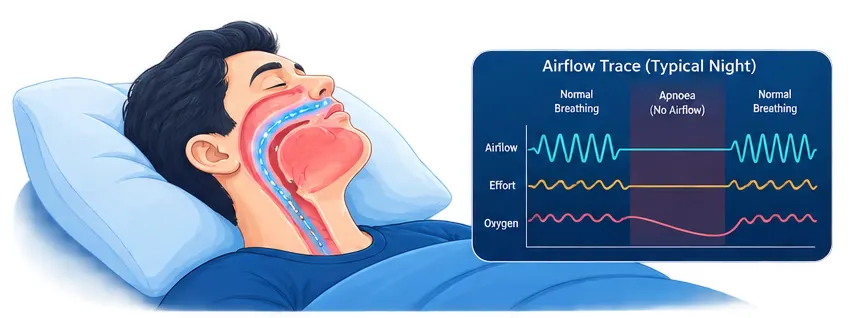
In the shaded band airflow has stopped. Oxygen falls, sleep breaks, and the night restarts again and again.
What happens in your airway
During sleep the muscles of your throat relax. In obstructive sleep apnoea the soft palate, tongue base and throat walls fall together and block the flow of air. Oxygen dips, your brain briefly wakes you to reopen the airway, and the cycle repeats — sometimes hundreds of times a night. You rarely remember these awakenings; you only feel the tiredness the next day.
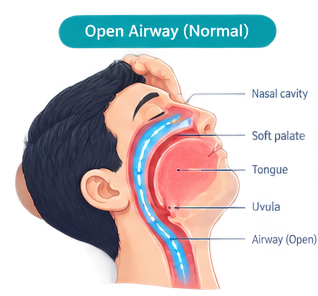
Air passes freely past the soft palate and tongue into the windpipe. Breathing is quiet and oxygen stays steady.
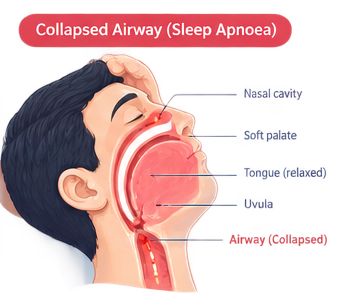
Relaxed tissue narrows the passage. Partial narrowing causes snoring; complete closure for ten seconds or more is an apnoea.
Loud snoring, choking or gasping, witnessed pauses in breathing, restless sleep, frequent trips to the bathroom, dry mouth on waking.
Morning headache, sleepiness while reading, watching TV or driving, poor concentration and memory, irritability, low mood, reduced libido.
Untreated apnoea raises the risk of high blood pressure, heart rhythm problems, stroke, poorly controlled diabetes and road accidents.
Could this be you?
Tick everything that applies. This is a simple awareness check, not a diagnosis — only a sleep study can confirm apnoea.
Tests we use to confirm it
Diagnosis begins with a clinic consultation — your sleep history, a look at your nose, mouth and throat, your neck size, weight and blood pressure. From there we choose the test that fits you.
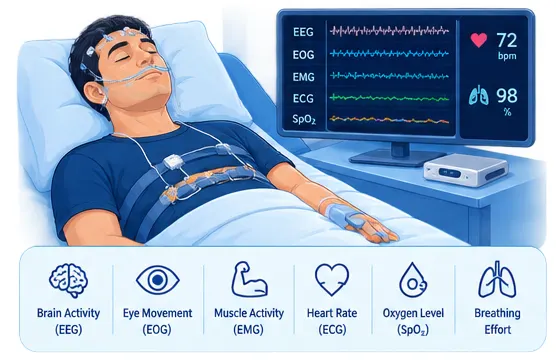
An overnight recording of your breathing, oxygen level, heart rate, brain waves, eye and leg movement. Soft sensors are taped on — nothing is painful and nothing breaks the skin. It tells us how many times an hour your breathing stops (the AHI), how low your oxygen falls, and how severe the apnoea is.
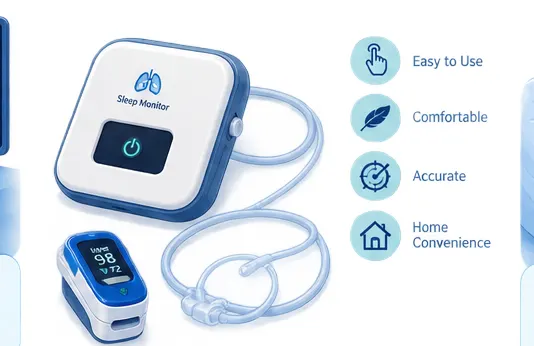
A small portable device you take home and wear for one night in your own bed. Suitable when the story strongly suggests apnoea and you have no other major heart or lung problem. We fit it, show you how to wear it, and read the download the next day.
Epworth sleepiness scale and STOP-BANG help us gauge how urgent testing is.
Nasal endoscopy where needed, plus spirometry (PFT) if asthma or COPD may coexist.
Thyroid, sugar, haemoglobin, ECG or echo — apnoea often travels with these conditions.
How sleep apnoea is treated
Treatment is built around your test result and your daily life. Most people use a combination: something that keeps the airway open at night, plus changes that reduce the load on the airway over months.
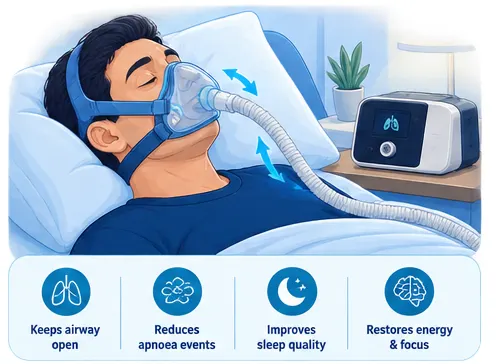
PAP therapy (CPAP / APAP / BiPAP)
A quiet bedside machine delivers gently pressurised room air through a mask. The air acts like a splint, holding your throat open so breathing does not stop. It is not oxygen and it does not breathe for you.
- Most people notice deeper sleep and less daytime sleepiness within one to two weeks.
- Masks come in nasal, pillow and full-face styles — comfort matters more than type, so we trial and change until it fits.
- Humidified air, ramp settings and a short mask-tolerance visit fix most early problems.
- We review your download at follow-up: hours used, residual AHI and mask leak guide the settings.
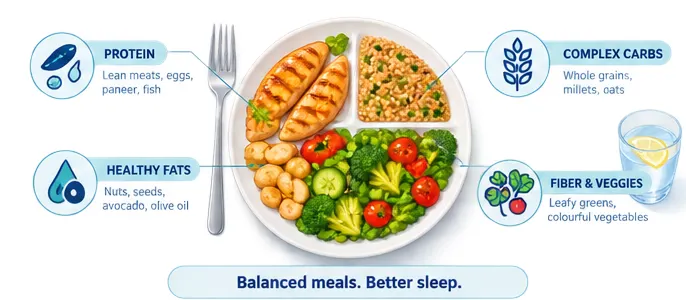
Diet and weight
Fat around the neck and abdomen narrows the airway. Losing even 5–10% of body weight can meaningfully reduce apnoea severity, and in mild cases can settle it.
- Fill half the plate with vegetables; choose millets, whole grains and dal over refined rice and maida.
- Cut sweetened drinks, fried snacks and late heavy dinners — finish eating three hours before bed.
- Avoid alcohol and sedative pills at night: both relax the airway further.
- Stop smoking — it inflames and swells the throat lining.
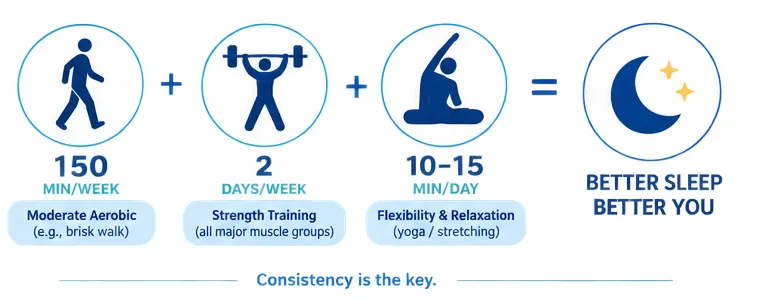
Exercise and airway training
Regular activity improves sleep quality and oxygen levels even before you lose weight. Throat and tongue exercises add a further small benefit in mild disease.
- Aim for 30 minutes of brisk walking, cycling or swimming, five days a week.
- Add two sessions of light strength work; build up slowly if you are very sleepy at present.
- Myofunctional therapy — tongue presses, palate and jaw exercises, 10 minutes daily.
- Pranayama and slow nasal breathing help nasal patency and relaxation before bed.
Side sleeping, a slightly raised head end, fixed sleep and wake times, and a dark quiet room. Positional aids help when apnoea occurs mainly on your back.
A custom dental device that holds the lower jaw forward. A good option for mild to moderate apnoea, or when PAP cannot be tolerated.
Treating allergy, a blocked nose, large tonsils or a deviated septum. ENT surgery is considered in selected patients after assessment.
If you feel sleepy at the wheel, avoid driving until your apnoea is treated and your sleepiness has settled. Tell us if your work involves driving or operating machinery.
Questions patients ask us
No. Snoring is the sound of a partly narrowed airway and many snorers do not have apnoea. Apnoea means the airway actually closes and breathing stops repeatedly. Only a sleep study can tell the two apart.
Common myths — and what is actually true
Sleep apnoea attracts more misunderstanding than almost any other lung condition. These are the ones that most often delay treatment.
“Snoring is harmless — it just annoys my family.”
Most snorers do not have apnoea, but loud snoring with witnessed pauses, gasping or daytime sleepiness needs a sleep study. Untreated apnoea strains the heart and blood pressure over years.
“Only very overweight people get sleep apnoea.”
Weight is a strong risk factor, but a narrow jaw, large tonsils, nasal blockage, hypothyroidism and increasing age also cause apnoea in people of normal weight.
“CPAP gives oxygen and breathes for me.”
A CPAP machine delivers gently pressurised room air, not oxygen. The pressure acts as a splint that keeps your throat from closing; your own breathing continues normally.
“I would know if I stopped breathing at night.”
Usually you would not. The pauses end in a brief arousal you do not remember — which is why a partner’s account, and the sleep study itself, matter more than your own impression of your sleep.
“A sleeping tablet will fix my broken sleep.”
Sedatives and alcohol relax the airway muscles and can make apnoea worse. Untreated apnoea should be excluded before sleeping tablets are used.
“If I cannot tolerate CPAP, there is nothing else.”
Most early intolerance is fixable — mask type, pressure ramp, humidification. Where it is not, an oral appliance, positional therapy, weight reduction or treating a blocked nose are genuine alternatives we assess.
When to seek medical attention urgently
- You feel sleepy while driving or operating machinery — stop driving until this is assessed
- Your partner sees long pauses in breathing, and you wake gasping or choking
- Blood pressure that stays high on three or more medicines, or a new irregular heartbeat
- Morning headaches with confusion or increasing daytime drowsiness
- Ankle swelling or breathlessness at rest alongside heavy snoring
Seek emergency care for chest pain, sudden severe breathlessness, fainting or an episode of slurred speech or one-sided weakness on waking.
When should you see a pulmonologist for snoring and sleep apnoea?
- You snore loudly and someone has seen you stop breathing in your sleep.
- You are sleepy in the daytime, at meetings or at the wheel, despite enough hours in bed.
- You have resistant high blood pressure, atrial fibrillation, stroke, or diabetes that is hard to control.
- You are already on CPAP but not improving, or you have stopped using it.
- You are being planned for bariatric or major surgery, or your child mouth-breathes and sleeps restlessly.
How Lung Care can help
- Sleep testing at the level you actually need — home study for straightforward cases, attended in-lab polysomnography when the picture is complex.
- Interpretation by a pulmonologist and sleep physician, so coexisting lung disease and daytime carbon-dioxide retention are not missed.
- PAP set-up done properly: pressure titration, mask fitting, humidification, and a review of your machine download at follow-up.
- Assessment of alternatives — oral appliance, positional therapy, weight and nasal treatment — when PAP is not the right answer.
- Practical advice on driving, surgery and anaesthesia while your apnoea is being treated.
Tests and services this involves
In-lab and home sleep testing to confirm obstructive sleep apnoea and grade its severity.
Device selection, pressure titration, mask fitting and download-based follow-up so therapy is actually used.
MBBS, DNB (Pulmonary Medicine), MNAMS, IDCCM, EDARM — consultant interventional pulmonologist and sleep physician, RS Puram, Coimbatore.
Used alongside sleep testing when COPD, asthma or obesity-related hypoventilation may coexist.
How to tell ordinary snoring from apnoea before you book a test.
Why apnoea and COPD together need different pressures and closer follow-up.
Sleep better, breathe easier
Bring your partner's account of your snoring, your medicine list and any past sleep report. We'll take it from there.
This page is general information for patients and does not replace a consultation. Please discuss your own symptoms and test results with Dr. Arun Gangadhar before starting or stopping any treatment.
About the sleep physician reviewing your study
Dr. Arun's professional website carries his sleep-medicine profile and qualifications.
Written and medically reviewed by Dr. Arun Gangadhar
MBBS, DNB (Pulmonary Medicine), MNAMS, IDCCM, EDARM — Consultant Interventional Pulmonologist & Sleep Physician, Lung Care, RS Puram, Coimbatore.
Published: June 2026 · Last reviewed: August 2026
References & guidelines
This page is general information, not a substitute for a consultation. For advice specific to you, book an appointment.